

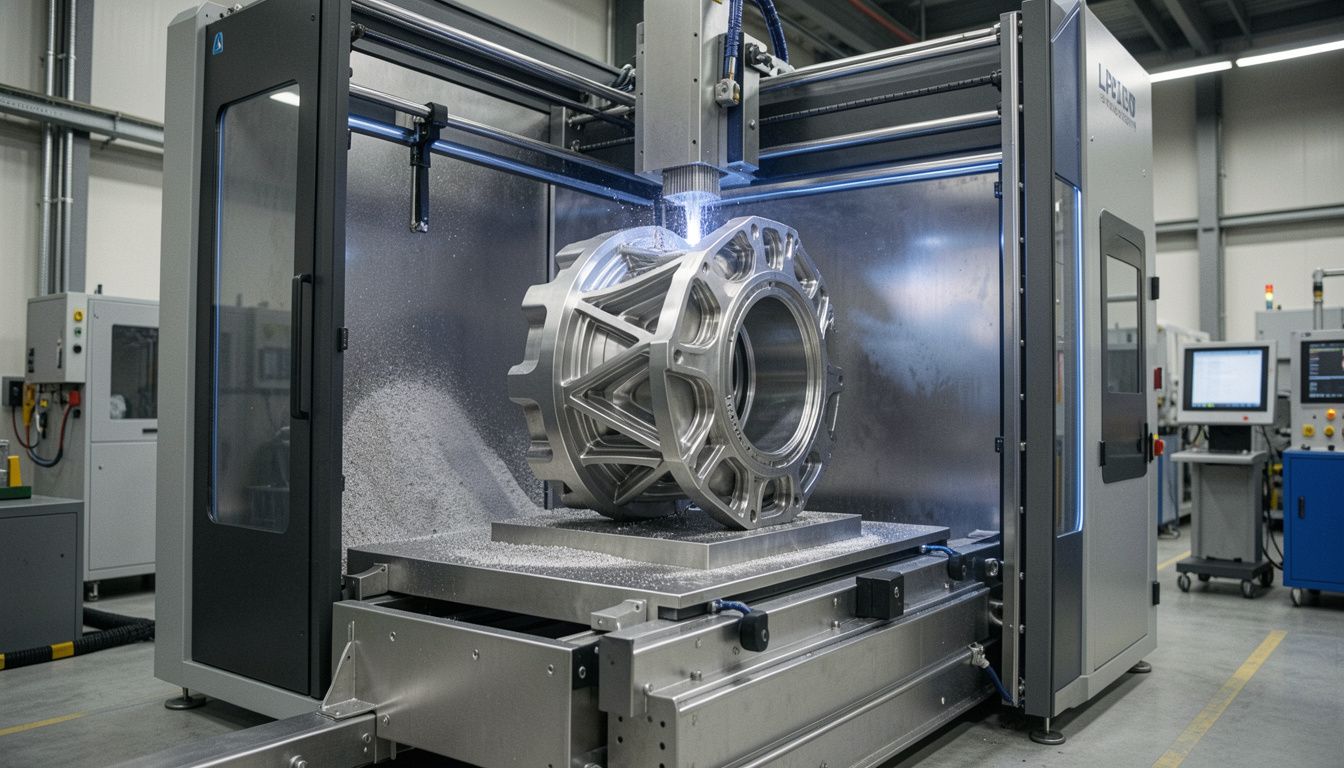

Choosing suitable parts for metal 3D printers depends on factors such as geometric complexity, material, dimensions, required quantity, accuracy, working conditions, and production cost.
In many industrial projects, additive manufacturing becomes more justifiable when producing a part using traditional methods requires molds, complex tooling, or multiple production stages.
Below, we examine the criteria for selecting a part, the characteristics of parts suitable for metal 3D printing, their applications in different industries, and the factors that can influence technical and economic decision-making.
What Parts Are Suitable for Production with a Metal 3D Printer?
In general, suitable parts are those that have high geometric complexity, are produced in limited quantities, require custom designs, or are difficult to manufacture using traditional methods.
Some of the most important examples include:
- Parts with complex geometries
- Parts with internal cavities and channels
- Lightweight parts
- Parts produced in limited quantities
- Custom parts
- Spare and obsolete parts
- Parts that require repair or refurbishment
One of the key characteristics of additive manufacturing is its ability to create complex geometries and internal structures that may be very difficult or even impossible to produce using conventional manufacturing methods.
Importance of Selecting Suitable Parts for Metal 3D Printers
A metal 3D printer is an advanced technology, but using it for every part is not necessarily technically or economically logical.
If a part is complex and only a limited number of units are required, the cost of producing a dedicated mold or tooling may not be economically justified. In such cases, additive manufacturing can be a more attractive option.
In contrast, for simple, high-volume parts, methods such as casting, forging, or machining may still offer lower production costs. Therefore, the manufacturing technology should be selected based on the actual characteristics of the part and the project requirements.
Characteristics of Parts Suitable for Metal 3D Printers
This section examines several important characteristics of parts suitable for metal 3D printers.
1. Parts with Complex Geometries
One of the most important criteria when selecting a part is its geometric complexity.
In traditional manufacturing methods, cutting tools must be able to access different surfaces of the part. Deep cavities, internal passages, specific angles, or nested structures can make machining more difficult.
In additive manufacturing, the part is built layer by layer from a digital model. This provides greater freedom for designing and producing complex geometries.
2. Parts with Internal Channels
The presence of internal channels is one characteristic that can make a part a suitable candidate for additive manufacturing.
These channels can be used for fluid flow, cooling, weight reduction, or improving thermal performance.
For example, cooling channels can be designed inside certain industrial parts. Producing such channels using traditional manufacturing methods can be extremely difficult.
3. Lightweight Parts
Another important application of metal 3D printing is producing parts that need to be lighter while maintaining the required strength and performance.
In the design of suitable parts, engineering design and topology optimization are highly important. In topology optimization, areas of material that do not play a significant role in the mechanical performance of the part are removed, while material is retained in areas that are essential for load-bearing.
This approach can reduce the weight of a part without removing its essential structural elements.
This characteristic is particularly important in industries such as aerospace, automotive, and advanced equipment manufacturing.
4. Parts Produced in Limited Quantities
Production volume is an important factor when selecting a manufacturing technology.
In traditional manufacturing, mold and tooling production may involve significant initial costs. When many parts are produced, these costs can be distributed across a large number of units and become economically justified.
However, when only a limited number of parts are required, the initial cost of molds and tooling can have a significant impact on the price of each part.
In such cases, a metal 3D printer can offer advantages because the part is produced directly from a digital model, reducing the need for certain dedicated molds and tools.
5. Custom Parts
One of the major advantages of metal 3D printing is the ability to quickly modify a design and produce different versions of a part.
With traditional methods, changing a design may require a new mold or tooling modifications. In additive manufacturing, however, modifying the digital model can make it possible to produce a new version of the part.
This feature is particularly valuable for custom parts, prototypes, and projects that require multiple versions of a component.
6. Spare and Obsolete Parts
In various industries, a part may no longer be available on the market because equipment has become outdated or the original manufacturer has discontinued production. In such cases, if a technical drawing, CAD model, or the original part is available, the part can undergo a digital reconstruction process.
This process may include measurement, reverse engineering, 3D scanning, and creating a CAD model.
After preparing the model, manufacturing the part using one of the additive manufacturing technologies can be evaluated. However, before production, the material, dimensional accuracy, operating conditions, and performance requirements of the part should also be assessed.
7. Parts That Require Repair or Refurbishment
Metal 3D printing is not limited to manufacturing new parts. In this context, suitable parts can also benefit from technologies such as DED, which make it possible to add material to an existing part.
In this process, the feedstock is delivered to the desired location and melted using a concentrated energy source before being deposited onto the surface of the part.
For this reason, DED can be used to repair damaged sections, restore surfaces, and extend the service life of certain components.

Which Parts Are Not Suitable for Metal 3D Printers?
Alongside identifying suitable parts, it is also important to understand which parts are generally not good candidates for metal 3D printing.
1- Simple and Low-Complexity Parts
If a part has a very simple geometry and can be manufactured using a simple machining process, additive manufacturing may not provide a significant advantage.
In such cases, cost, production time, and required accuracy should be compared between traditional manufacturing and 3D printing.
2- Very High-Volume Parts
For some simple parts that need to be produced in very large quantities, methods such as casting, forging, or machining may be more economical.
However, this also depends on the part geometry, material, production volume, and tooling and mold costs.
3- Parts Whose Dimensions Exceed the Machine Capacity
Part dimensions are an important limitation of any additive manufacturing technology. If the dimensions of a part exceed the build volume of the machine, another suitable manufacturing method must be selected, or the possibility of manufacturing the part in multiple sections and assembling them should be evaluated.
4- Parts Whose Process Requirements Are Not Compatible with the Technology
Not every metal or alloy can be produced with every metal 3D printer. Material printability, thermal behavior, required mechanical properties, and available equipment should be evaluated before starting the project.
Therefore, simply having a complex geometry does not necessarily mean that a part is suitable for metal 3D printing.
5- The Role of Material in Selecting Parts Suitable for Metal 3D Printing
Material selection is one of the most important factors in choosing a manufacturing process. Different metals behave differently during melting, solidification, and cooling, which can affect the quality of the final part.
6- Stainless Steel
Stainless steels are considered important materials in metal additive manufacturing because of their strength, corrosion resistance, and wide range of industrial applications.
These materials can be used for industrial parts, equipment, tools, and various engineering applications.
7- Aluminum Alloys
Aluminum is widely considered for lightweight applications because of its low weight and favorable strength-to-weight ratio.
These materials can be used for aerospace and automotive parts as well as certain thermal equipment.
8- Titanium Alloys
Titanium offers a combination of low weight, high strength, and suitable corrosion resistance.
For this reason, it is used in aerospace applications as well as certain medical and advanced engineering applications.
9- Nickel-Based Alloys
Nickel-based alloys are highly important for applications that require resistance to high temperatures and harsh operating conditions.
These materials are used in certain components for energy, aerospace, and other demanding environments.
10- Copper Alloys
Copper and some of its alloys have attracted attention because of their high thermal and electrical conductivity.
This characteristic makes them suitable for designing components such as heat exchangers and certain thermal components.
Therefore, when selecting a suitable part for metal 3D printing, geometry alone is not sufficient. The appropriate material must also be selected based on the operating conditions.
The Role of Manufacturing Technology in Part Selection
The type of technology is also important in determining whether a part is suitable. Each additive manufacturing technology covers a specific range of dimensions, geometries, materials, and applications.
- LPBF
Laser Powder Bed Fusion is suitable for producing small- and medium-sized parts with high geometric detail.
In this technology, thin layers of metal powder are placed on the build bed, and the laser melts the specified sections. LPBF can be a suitable option for parts that require high accuracy and complex structures.
- DED
Directed Energy Deposition technology uses feedstock in the form of powder or wire and deposits it at the desired location while simultaneously applying energy.
DED is particularly useful for large parts, repairing existing components, and adding material to metal structures.
Therefore, a part may be suitable for DED but not for LPBF, and vice versa.
For a more detailed comparison of these two technologies, you can read the article Examining the Difference Between DED and LPBF Technologies in Metal 3D Printers on the website.
What Parts Are Manufactured with Metal 3D Printers in Different Industries?
- Aerospace Industry
The aerospace industry is one of the fields that requires lightweight, strong, and complex parts.
Brackets, housings, engine components, nozzles, and certain structural components can, under appropriate conditions, be manufactured using additive manufacturing technologies.
Weight reduction and the ability to produce complex geometries are among the main reasons this industry is increasingly interested in metal 3D printers.
- Oil, Gas, and Petrochemical Industries
In the oil, gas, and petrochemical industries, components such as nozzles, valve components, pump parts, and specialized spare parts can be considered candidates for additive manufacturing.
In particular, when a part is complex or difficult to source from the original manufacturer, additive manufacturing can be evaluated as an alternative.
Power Generation and Energy Industries
In power plants, certain components are exposed to temperature, pressure, corrosion, and mechanical loads.
For these industries, manufacturing complex parts as well as repairing or refurbishing certain existing components can be important applications of technologies such as DED.
- Steel and Mining Industries
In the steel and mining industries, large components, wear-exposed equipment, and specialized spare parts are particularly important.
DED can be suitable for some of these applications because of its high deposition rate and ability to work with large parts.
- Medical Industry
In some medical applications, the ability to produce customized parts and complex geometries is highly important.
Additive manufacturing can be used to produce certain implants, medical tools, and components that require customized designs.
How Can We Determine Whether a Part Is Suitable for Metal 3D Printing?
A multi-stage evaluation process can be used to assess parts suitable for metal 3D printers.
Step One: Geometry Evaluation
First, it should be determined whether the part has a geometry that would be difficult to manufacture using traditional methods.
Internal cavities, channels, specialized walls, and complex structures can be positive indicators for additive manufacturing.
Step Two: Production Volume Evaluation
The required quantity of the part should be determined. If only a few parts are needed, suitable parts for metal 3D printers may be more attractive than manufacturing methods that require dedicated molds or tooling.
Step Three: Material Evaluation
It should be determined whether the required material can be produced using the available technology and equipment.
At this stage, the material's printability and the required properties of the part should also be evaluated.
Step Four: Dimensional Evaluation
The dimensions of the part must be compatible with the build capacity of the machine.
The space required for supports, the part's orientation on the build bed, and the possibility of performing post-processing should also be considered.
Step Five: Performance Requirements Evaluation
Tolerances, surface roughness, strength, thermal resistance, corrosion resistance, and other performance requirements should be defined.
This evaluation helps determine whether additive manufacturing can provide the required quality for the final application.
Step Six: Post-Processing Evaluation
For many industrial parts, printing is not the final production stage. The part may require heat treatment, CNC machining, surface finishing, or non-destructive testing.
Therefore, the complete production process should be defined from the beginning, including all required stages.
The Role of Design in Parts Suitable for Metal 3D Printing
Sometimes a part in its current form is not a suitable candidate for additive manufacturing, but it can become a much better candidate through redesign.
For example, it may be possible to:
- Reduce the weight of the part.
- Reduce the number of assembled components.
- Create internal channels.
- Design lattice structures.
- Optimize cooling paths.
- Optimize the part geometry for the printing process.
For this reason, when evaluating a project, the existing part model should not be the only consideration. The possibility of redesigning the part for additive manufacturing should also be evaluated.

Summary
What parts are suitable for metal 3D printers? The answer depends on a combination of technical and economic factors.
Parts with complex geometries, internal channels, lightweighting requirements, low production volumes, customization requirements, or supply challenges can generally be suitable candidates for additive manufacturing.
Spare and obsolete parts are also an important application area for this technology, as producing a part based on a digital model can reduce lead times and dependence on inventory.
On the other hand, simple, high-volume, and low-complexity parts may still be more economical to produce using methods such as casting, forging, or machining.
Therefore, before selecting a metal 3D printer for manufacturing a part, it is better to evaluate the geometry, material, production volume, dimensions, performance requirements, cost, and post-processing requirements as an integrated process.
Frequently Asked Questions
What types of parts are suitable for metal 3D printers?
Complex, customized, low-volume parts, parts with internal channels, lightweight parts, specialized tools, and spare or obsolete parts can be suitable candidates for production with metal 3D printers.
Are all parts suitable for metal 3D printing?
No. A part's manufacturability depends on factors such as material, dimensions, geometry, printing technology, machine capacity, and performance requirements.
Are simple parts suitable for metal 3D printing?
In some cases, yes. However, if a part is simple and can be manufactured at a lower cost using methods such as CNC machining or casting, 3D printing may not offer an economic advantage.
Can spare parts be manufactured with a metal 3D printer?
Yes. If a CAD model, technical drawing, or original part is available for reverse engineering, many spare parts can be evaluated for production using additive manufacturing technology.
Are large parts suitable for metal 3D printers?
It depends on the technology used. DED can be a suitable option for certain large parts because of its high deposition rate and ability to operate in multi-axis systems.
Is it possible to manufacture customized parts with a metal 3D printer?
Yes. One of the advantages of additive manufacturing is the ability to produce customized parts based on a digital model and the specific requirements of each project.
Is metal 3D printing suitable for mass production?
In some applications, yes. However, for simple and very high-volume parts, traditional manufacturing methods may be more economical. Additive manufacturing generally offers greater advantages for complex, customized, or low-volume parts.
What materials can be used to manufacture metal parts with a 3D printer?
Depending on the technology and machine, materials such as stainless steel, aluminum, titanium, nickel-based alloys, and some copper alloys can be used.
How can we determine whether a part is suitable for metal 3D printing?
The geometry, material, dimensions, production volume, performance requirements, traditional manufacturing methods, tooling and mold costs, and post-processing requirements should all be evaluated.
Sources
The Steel Printers – A Brief Guide to the Metal 3D Printing of Spare Parts
Markforged – Metal 3D Printing Materials
UltiMaker – 3D Metal Printing: Revolutionizing Manufacturing with Advanced Metal Parts
نظرات
0 نظر
دیدگاهی ثبت نشده.